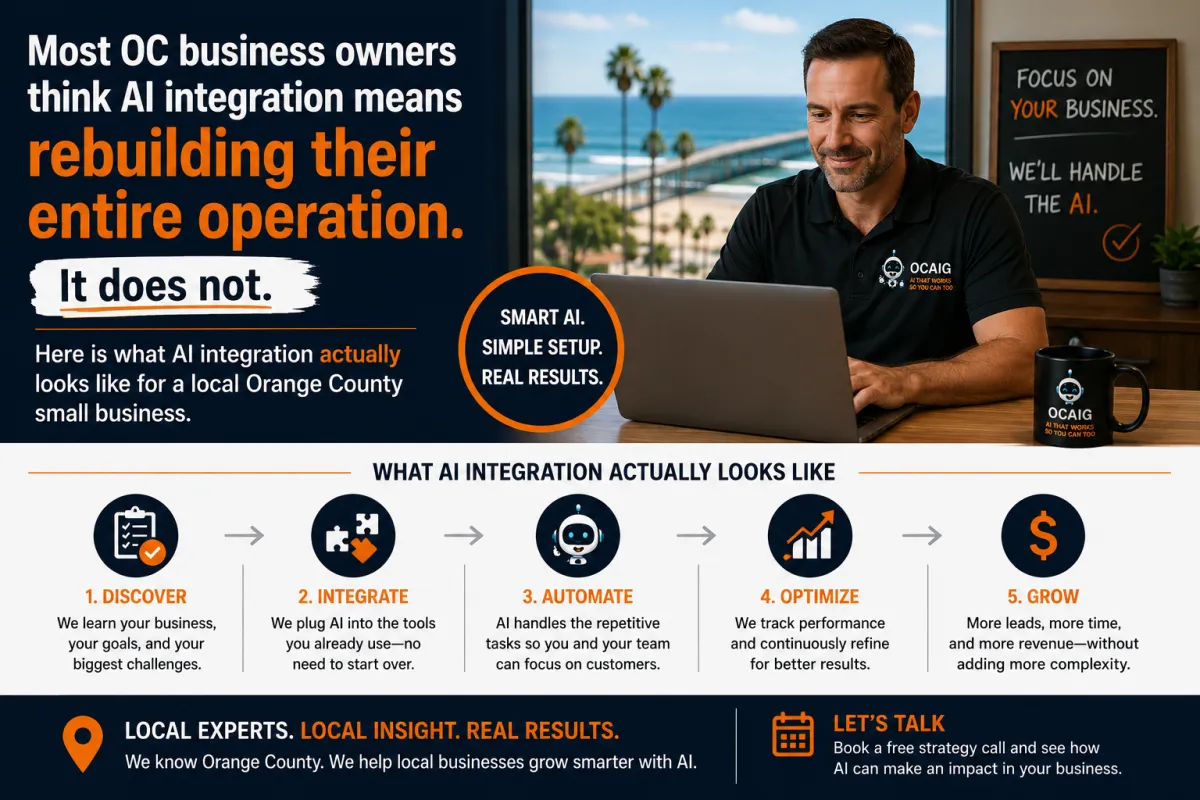
How AI Integration Works for Orange County Small Businesses (Without the Technical Headache)
By Ben Williamson, Orange County AI Guy
The question I hear most often from Orange County business owners who are curious about AI but haven't done anything yet is some version of this: "How complicated is it actually going to be?"
It's a fair question. The way AI gets discussed in the media and in marketing materials makes it sound like implementing it requires a technical team, a budget rewrite, and three months of platform migration. For most OC small businesses, none of that is true.
I'm Ben Williamson, the Orange County AI Guy. When I install AI Systems for local OC businesses, the goal is always the same: connect to what's already there, fix what's actually broken, and don't create new complexity in the process. Here's what AI integration actually looks like from a business owner's perspective.
What AI Integration Is Not
Before explaining what integration looks like, it helps to clear up what it isn't:
●It is not replacing your booking system with a new platform.
●It is not rebuilding your website from scratch.
●It is not hiring a technical employee to manage AI tools.
●It is not a months-long implementation project with weekly progress calls.
●It is not installing dozens of tools that you'll need to learn and manage separately.
For most Orange County service businesses, AI integration is connecting a small number of AI Systems to the tools the business already uses, configuring them for the business's specific workflows, and making sure they're running correctly before anything goes live.
What AI Integration Actually Looks Like: A Typical OC Business Example
Here's a representative example. A San Clemente salon currently uses a booking platform, a phone, and a Gmail account to run their client communication. AI integration for that business looks like this:
●An AI chatbot connects to the website and links to the booking platform. When a client asks to book a blowout on Saturday, the chatbot checks availability and confirms the booking directly. No new booking platform needed.
●An AI voice agent connects to the phone line via call forwarding. When the phone rings and nobody can answer, the agent picks up, handles the call, and books the appointment if the caller wants one. The existing phone number stays the same.
●An SMS follow-up sequence connects to the booking platform data. When an appointment is booked, a confirmation goes out automatically. Two days before, a reminder. One day before, a final confirm. All triggered by the existing booking system.
●A review request sequence triggers after each completed appointment and sends a one-tap Google review request. Connects to the same booking data.
The salon's booking platform didn't change. The phone number didn't change. Gmail is still Gmail. What changed is that four AI Systems are now running on top of the existing infrastructure, handling communication tasks that were previously manual or not happening at all.
The 5 Steps of an AI Integration for an OC Small Business
Step 1: Strategy call and assessment
Before anything is built, we identify specifically where the business is losing money and which AI Systems address those gaps. This is not a generic AI assessment. It's a specific diagnosis of the business's actual operational leaks.
Step 2: System design
Based on the assessment, the right combination of AI Systems is identified, along with how each one connects to the existing tools. No unnecessary systems, no complexity that doesn't serve a specific business problem.
Step 3: Build and configuration
The AI Systems are built and configured specifically for the business. Scripts, workflows, and sequences are written in the business's voice. Integration connections are established and tested.
Step 4: Approval and testing
Nothing goes live without Ben's review and the business owner's explicit approval. Every AI System is tested on realistic scenarios before it encounters real customers. This is the human-in-the-loop checkpoint.
Step 5: Go live and optimize
The systems go live. Performance is monitored in the first weeks to identify any adjustments needed. Optimization is ongoing as real-world data comes in.
What "Human in the Loop" Means in Practice
One of the most important principles I build into every AI integration is human-in-the-loop governance. This means the AI Systems handle everything they're configured for, and they route to a human when they hit the edge of their configuration.
For a business owner, this means you never need to worry that your AI Systems are making decisions or sending messages you didn't approve. The systems were approved before they went live. They operate within the parameters you set. And anything outside those parameters comes to you.
Frequently Asked Questions
Do I need to replace my existing tools to integrate AI Systems?
Almost never. AI Systems are designed to connect to existing tools rather than replace them. The goal is adding AI capabilities to what already works, not rebuilding the technology stack from scratch. The assessment phase identifies which connections are feasible and which, if any, tools need to change.
How long does AI integration take for an Orange County small business?
A core integration covering chatbot, voice agent, and follow-up sequences typically takes 7 to 10 business days from strategy call to live systems. More complex integrations with multiple systems and deeper CRM connectivity take longer. The assessment call at the start gives an accurate timeline for the specific business.
What technical knowledge do I need as the business owner?
None beyond what you already have. The integration is built and managed by the implementer. What you need to do as the business owner is review and approve the systems before they go live, and provide feedback during the optimization phase. No coding, no platform administration, no technical management required.
What if something goes wrong after the AI Systems go live?
Every AI integration includes a post-launch monitoring period. If something isn't working as expected, it's identified and corrected quickly. The human-in-the-loop design means that edge cases route to you rather than creating bad customer experiences.
Key Takeaways
●AI integration for most Orange County small businesses means connecting AI Systems to existing tools, not replacing them.
●A typical integration covers chatbot, voice agent, and follow-up sequences and takes 7 to 10 business days.
●The process includes strategy call, system design, build and configuration, approval and testing, and go-live, with no system activated without explicit business owner approval.
●Human-in-the-loop governance means AI Systems handle what they're configured for and route everything else to the owner.
●No technical knowledge is required from the business owner. The integration is built and managed by the implementer.
Ben Williamson is the founder of Orange County AI Guy, based in San Clemente, CA. He installs AI Systems for local Orange County businesses across every niche, serving all 30+ OC cities. Visit orangecountyaiguy.com to learn more.
Ready to explore what AI Systems can do for your Orange County business? Schedule a free Strategy Call -> https://api.leadconnectorhq.com/widget/booking/64FMtWKC7HC4z1hPc54Q